
Air Quality
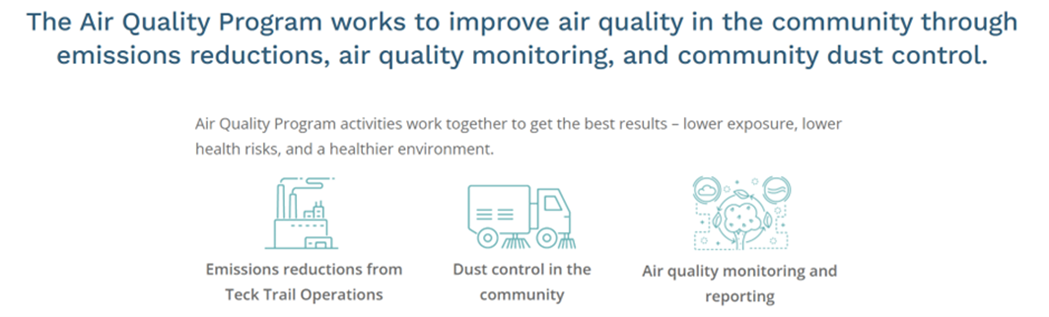
The two briefs below provide some further context and information on the Air Quality program.
How community leadership transformed air quality in Trail
In the early 1990s, growing concern about children’s blood lead levels sparked a powerful community movement in Trail. Parents, residents, and local leaders began asking hard questions, pushing for answers, and calling for action. Their involvement led to the formation of a unique partnership between Cominco (now Teck), the City of Trail, the BC Ministry of Environment, and the Ministry of Health – a collaborative task force built on transparency, shared decision-making, and equal voice.
Through open meetings, public dialogue, and evidence-based discussion, community representatives helped shift the focus from historic soil contamination to current air emissions as the primary driver of elevated blood lead levels. Data showed clear correlations between smelter emissions and children’s health outcomes, which helped support the company’s decision to replace the old lead smelter with cleaner technology. The result was a dramatic reduction in emissions and a steady decline in children’s blood lead levels.
Trail’s experience is now recognized internationally as a model of how community involvement, scientific transparency, and industry-government collaboration can drive meaningful environmental change. The legacy continues through THEP and THEC, where engagement, transparency, and shared responsibility remain central. The story is a reminder that every voice matters – and that individuals joining the program today are part of a long-standing tradition of collaboration and community-led progress.
To view the full case study and read about this work in more detail, click here:
Reducing fugitive dust to improve air quality
Over several decades, Trail made significant progress in reducing lead exposure by targeting stack emissions from the smelter. These efforts led to dramatic improvements in air quality and steady declines in children’s blood lead levels. By the mid-2010s, however, a turning point was reached: stack emissions were already very low, and further improvements would require looking beyond traditional point sources.
This shift led to a renewed focus on fugitive dust: fine particles released from roads, material handling areas, outdoor storage piles, and buildings across the site. While each source may contribute only small amounts of lead, together they represent an opportunity to further reduce airborne lead in the community.
Guided by monitoring data and Interior Health’s analysis showing a strong relationship between lead in air and children’s blood lead levels, the Medical Health Officer has emphasized air quality improvements – particularly fugitive dust reduction – as a priority for continued progress. Teck has implemented a Fugitive Dust Reduction Program that combines major capital investments with everyday operational changes. These include housing lead-bearing materials inside the smelter recycle building, installing and expanding a large wind fence to reduce dust movement, improving road dust control and wheel washing, and identifying dust sources inside buildings.
Ongoing monitoring is central to this work. Total Suspended Particulate (TSP) stations and a long-standing dustfall network help track trends, evaluate the effectiveness of projects, and guide future action. Together, these tools ensure that fugitive dust reduction efforts are evidence-based and responsive.
Reducing fugitive dust benefits both the community and workers, and it depends on strong collaboration between THEP, Teck, government partners, health authorities, and residents. As this work continues to evolve, it represents an important next step in Trail’s long-term, community-led effort to protect health and build on decades of environmental progress.
To view the full brief and read about this work in more detail, click here: